Choosing Between Liquid Termite Barriers and Baiting Systems for Your Home
Compare liquid termite treatments and baiting stations to determine the best subterranean termite defense for your Nashville property, foundation, and soil.
The Subterranean Threat to Nashville Properties
Throughout Middle Tennessee, subterranean termites are an active component of the native ecosystem. While they play an essential role in breaking down fallen timber in forests, their foraging behavior poses a constant structural threat to residential properties. Because these insects live underground and travel through subterranean foraging galleries and mud tubes, protecting a structure requires a proactive defense rather than a reactive fix.
When planning a termite defense strategy, homeowners typically evaluate two proven methodologies: liquid soil treatments and in-ground baiting systems. Both methods have advanced significantly over the past two decades, yet they operate on distinctly different biological and chemical principles. Selecting the right protection strategy depends on your home’s architectural design, surrounding landscape, soil characteristics, and long-term maintenance preferences.
How Liquid Termite Barriers Work
Liquid termite treatments involve applying a continuous chemical zone into the soil around the exterior foundation of a home. In homes with crawl spaces, treatments are often extended along interior foundation walls, around support piers, and along structural expansion joints.
The Mechanism of Modern Non-Repellents
Older generation termiticides acted as repellent barriers, turning foraging workers away from treated zones. If a gap occurred in the soil coverage, termites would simply navigate around it until finding an entrance. Modern liquid termiticides, however, utilize non-repellent formulations.
Subterranean termites cannot detect, smell, or taste these non-repellent active ingredients. As they move through treated soil, microscopic residues adhere to their cuticles. Because termites are social insects that continuously groom one another and share food through mutual exchange, affected individuals inadvertently distribute the active compound throughout the colony. This process leads to colony suppression while maintaining a protective boundary around the immediate foundation.
Installation and Application Process
Installing a liquid treatment requires establishing a continuous trench in the soil along the perimeter of the foundation. The termiticide is mixed with water and applied into the trench to saturate the soil column down to the top of the foundation footings. Where concrete patios, carports, driveways, or sidewalks abut the exterior wall, technicians must drill small holes through the slab at regular intervals to inject the product beneath the concrete, after which the holes are patched flush with specialized concrete plugs.
How Termite Baiting Systems Work
Rather than establishing a continuous chemical zone in the soil, baiting systems exploit the natural, continuous foraging habits of subterranean termites to eliminate colonies from the outside in.
The Mechanism of Insect Growth Regulators
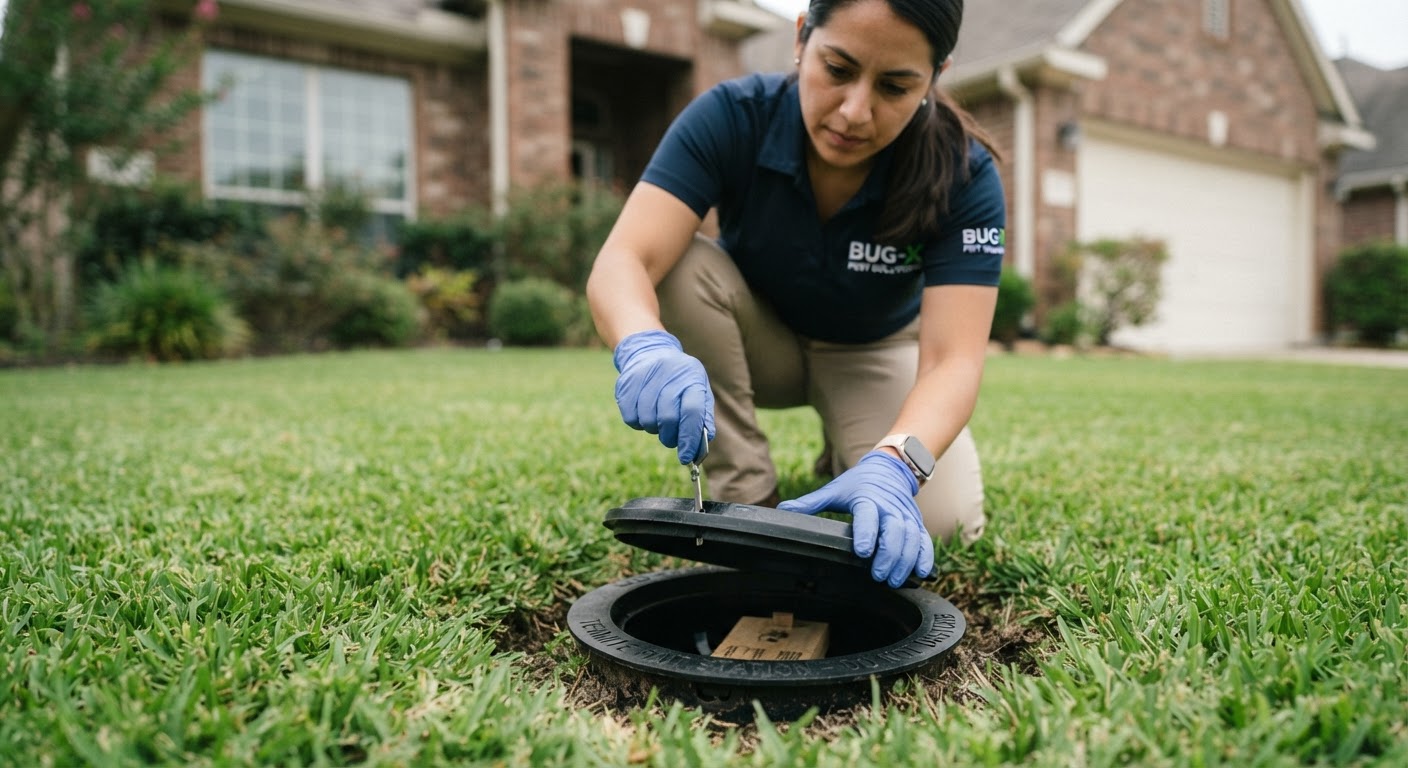
Bait stations are discreet, cylindrical plastic units installed flush with the ground in the soil perimeter surrounding the structure. Inside the stations, cellulose-based bait matrices are placed containing an Insect Growth Regulator (IGR), such as a chitin synthesis inhibitor.
Termites continually forage for cellulose food sources, even when established food sources already exist. Once foraging worker termites encounter a bait station, they feed on the matrix and recruit nestmates to the station using trail pheromones. The IGR prevents immature termites from properly synthesizing chitin during their molting process. Unable to form their new exoskeletons, the workers perish. As the worker caste collapses, the reproductive queen and soldier castes starve, leading to complete structural elimination of the attacking colony.
Installation and Monitoring Requirements
Baiting systems are installed around the home at measured intervals, typically every ten to twenty feet, following the dripline and foundation perimeter. Unlike liquid barriers, baiting systems do not require drilling through finished concrete slabs, extensive digging, or moving heavy landscaping materials unless access to bare soil is completely blocked. However, bait systems require consistent professional monitoring and bait cartridge replacement to ensure that active material remains available whenever foraging termites pass through.
Liquid Barriers vs. Baiting Systems: Key Comparison Factors
Evaluating which strategy provides the best defense for your home involves looking closely at the specific conditions of your property.
1. Geological and Soil Considerations
The geography of the Nashville basin presents unique challenges for termite management. Dense clay soils and shallow limestone bedrock can directly affect liquid applications. High clay concentrations can reduce soil porosity, making it more labor-intensive to achieve uniform saturation down to the foundation footings. Additionally, in areas with karst topography or shallow rock shelves, establishing a continuous trench can be difficult without encountering immovable rock close to the surface.
Baiting systems bypass many of these issues because they do not require deep soil saturation. While rocky ground can occasionally require adjusting station placement slightly, stations remain functional regardless of whether the surrounding soil is tightly packed clay or porous loam.
2. Foundation Architecture
The construction style of your home plays an essential role in system performance:
- Monolithic and Floating Slabs: Slabs often have hidden plumbing penetrations beneath interior rooms where termites can enter undetected. Liquid treatments require precise perimeter trenching and sometimes interior slab drilling. Bait stations circle the exterior perimeter and can intercept colonies long before they reach the slab edge.
- Crawl Space Foundations: Crawl spaces are common across Middle Tennessee. Liquid treatments excel here because a technician can directly treat the crawl space perimeter and pier bases, providing a physical boundary right where moisture and wood framing converge.
- Basements and Multi-Level Foundations: Deep basement walls require treating soil down to significant depths. If the exterior grade has been backfilled with gravel or heavy rubble, achieving a uniform liquid barrier against the foundation wall can be challenging, often making bait systems an advantageous primary or supplementary defense.
3. Environmental Sensitivity and Wells
If your property is situated near natural springs, creeks, stormwater retention ponds, or private drinking water wells, liquid termiticide applications are governed by strict environmental buffers. In situations where a high water table or nearby open water makes large-volume soil saturation inadvisable, termite baiting stations offer a contained, target-specific alternative that eliminates risks associated with chemical runoff or groundwater movement.
4. Longevity and Maintenance Demands
Liquid barriers provide continuous protection once installed. Undisturbed treated soil remains effective for multiple years, though structural additions, landscaping projects, soil erosion, or pipe replacements can disrupt the chemical envelope and necessitate spot treatments.
Conversely, baiting systems rely on ongoing vigilance. A bait station left unmaintained or depleted of bait matrix provides zero structural defense. Homeowners who select baiting systems must commit to regular annual service plans so professional technicians can inspect station integrity, check for termite consumption, and replace degraded cellulose components.
Can You Combine Both Strategies?
In many high-pressure scenarios, liquid barriers and bait systems are used in tandem. For example, a home with an active crawl space infestation may receive an immediate, targeted liquid application to stop termites from continuing to feed on floor joists, paired with an exterior baiting system around the lawn perimeter to suppress larger subterranean populations foraging throughout the yard. This integrated pest management approach halts current structural damage while lowering broader colony density across the property.
Choosing the Right Defense for Your Property
There is no universal solution for subterranean termite management. Homes built on level ground with accessible perimeter soil may benefit from the long-lasting stability of a non-repellent liquid barrier. Properties surrounded by hardscaping, rock outcroppings, or steep slopes may find an advanced baiting network to be the less invasive and more adaptable defense.
A thorough structural inspection by an experienced professional is the first step toward evaluating foundation depth, crawl space conditions, moisture levels, and entry risks. Copper Wren Pest Control provides comprehensive residential termite inspections and customized management strategies designed specifically for Nashville properties. Contact Copper Wren Pest Control today to schedule an evaluation and protect your home from subterranean termites.
Need help from Copper Wren Pest Control?
Contact our team to discuss your service needs in Nashville and surrounding service areas.